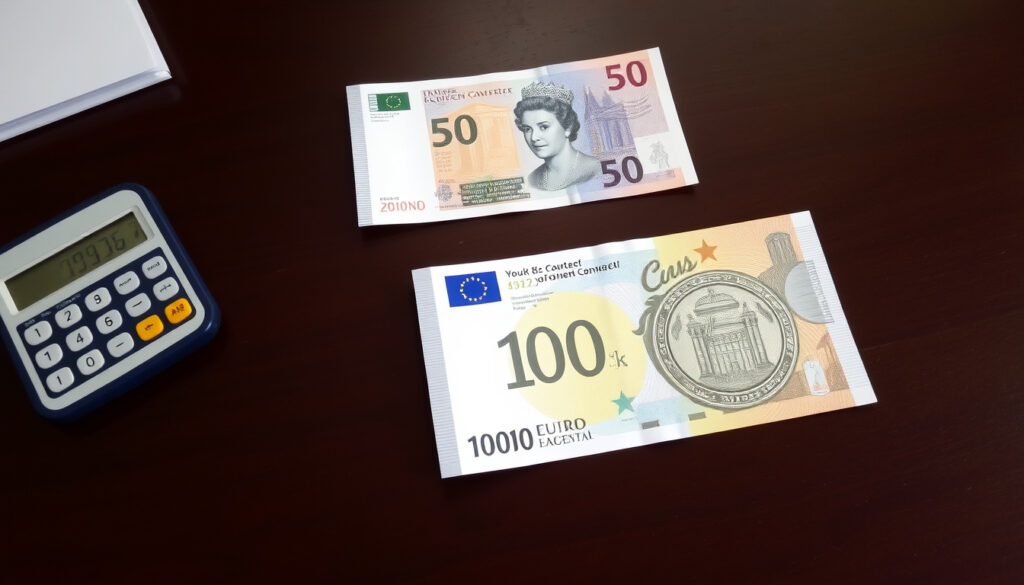
10000 Pound in Euro : Current Rate & How to Convert
You’ve got £10,000 you need to move into euros — and suddenly the difference between a good rate and a bad one feels personal. At today’s mid-market rate that’s about €11,595, but banks and exchange services quietly carve out their share through markups and fees. This guide shows you exactly what £10,000 is worth in euros right now, how much you lose with typical providers, and how to keep more of your money.
Current mid-market rate: 1 GBP to EUR 1.1596 EUR (Wise and Xe) ·
10,000 GBP at mid-market 11,595.50 EUR (Wise) ·
Typical bank markup 2–4% above mid-market
Quick snapshot
- Mid-market rate: 1 GBP ≈ 1.1596 EUR (Xe, a recognised currency data provider)
- £10,000 at mid-market = €11,595.50 (Wise, a transparent online transfer service)
- Banks charge 2–4% markups (Regency FX, a currency specialist)
- Future exchange rate movements
- Exact fee schedules for all currency exchange services
- Influence of economic data releases on GBP/EUR
- Comparison of all available exchange services’ exact fees and spreads
- GBP/EUR rate at 1.15619 as of 11 September 2025 (MTFX, a commercial currency broker)
- Compare live rates across providers before transferring
- Choose a service with low fees and mid-market‑linked rates
Four key facts summarise the landscape: the official mid-market rate, what £10,000 yields at that rate, and the typical hit from bank markups versus online specialists.
| Factor | Value | Source |
|---|---|---|
| Mid-market rate | 1 GBP = 1.1596 EUR | Pound Sterling Live, a specialist currency site |
| 10,000 GBP at mid-market | 11,595.50 EUR | Wise |
| Typical bank markup | 2–4% | Regency FX |
| Online specialist fee range | 0.4–1% | CurrencyTransfer, a comparison platform |
How much is 1 pound to 1 euro today?
What is the mid-market rate?
The mid‑market rate — also called the interbank rate — is the rate banks use when trading large volumes among themselves. As of the latest data from Xe (real‑time converter) and Wise (live mid‑market chart), 1 British pound buys about 1.1596 euros. This is the purest available exchange rate, free of any retail margin.
How does the interbank rate differ from retail rates?
- Banks add a spread of 2–4% on top of the mid‑market rate, either as a worse rate or as an explicit fee. Regency FX (transfer guide) states that bank charges can reach 4–5% of the amount transferred, plus flat transfer fees of £15–£40.
- Online specialists such as Wise and CurrencyTransfer offer rates very close to the mid‑market, often adding just a small percentage fee (0.4–1%). CurrencyTransfer notes that for £10,000, a better exchange rate matters far more than the fixed fee.
The implication: even a 0.5% improvement in the rate can put an extra €57 in your pocket compared with a high‑spread provider.
“Banks can charge up to 4–5% of the money transferred.” — Regency FX, a currency specialist
Key takeaway: The mid‑market rate is your benchmark. Any service that quotes a rate below that is effectively charging a hidden fee. The difference between 1.1596 and 1.1079 — the Post Office’s online cash rate for £100+ — on £10,000 is €517 lost.
How many euros are in 10,000 pounds?
How much is £10,000 in euros using mid-market rate?
At the mid‑market rate of 1.1596, the calculation is straightforward:
- £10,000 × 1.1596 = €11,595.50 (Xe and Wise both show this figure at the live rate).
- Pound Sterling Live quotes a market rate of 1.1596 and states that £10,000 would convert to €11,555 at its top‑weighted provider.
How does the amount change with transfer fees?
Instarem (online money transfer service) shows £10,000 converting to €11,563.20 — close to the mid‑market baseline. In contrast, the Post Office (travel money provider) lists online euro rates of 1.1079 for £100+ and 1.1362 for £1,000+, which would yield only about €11,079 or €11,362 respectively for £10,000 — a gap of €516 to €233.
The catch: the provider you choose can easily shift the final amount by several hundred euros even before you factor in flat transfer fees.
“At £10,000, the exchange rate matters more than fixed fees.” — CurrencyTransfer, a comparison platform
Key takeaway: For a £10,000 transfer, the difference between a mid‑market specialist and a traditional bank can be over €350 — enough to cover a weekend in many European cities.
Is the Pound strong against the euro?
What factors affect GBP/EUR strength?
Exchange rates between the pound and the euro move with interest‑rate decisions, inflation data, GDP growth, and market sentiment. Pound Sterling Live notes that their rates are indicative and reflect current market conditions. When the Bank of England raises rates, the pound often strengthens relative to the euro.
How has the rate changed recently?
MTFX (commercial broker) recorded a rate of 1.15619 on 11 September 2025 — slightly below the 1.1596 mid‑market quoted by Wise and Xe, reflecting a typical retail margin. Over the past year the pound has traded in a range of roughly 1.10–1.20 against the euro, so the current level sits near the stronger end.
For anyone converting a large sum, waiting for a favourable movement can pay off, but timing the market is risky. The safest approach is to lock in a rate with a specialist provider when you’re ready to transfer.
The pattern: currency strength fluctuates with economic signals, but the key is to lock in a good rate when you see it rather than attempt to outguess the market.
Three provider types, one key trade‑off: convenience vs. cost. The comparison below shows how much you actually receive for £10,000.
| Provider type | Example rate (GBP→EUR) | € you get for £10,000 | Typical fee structure |
|---|---|---|---|
| Mid‑market benchmark | 1.1596 | €11,595.50 | No fees (reference) |
| Online specialist (Instarem) | ~1.1563 | €11,563.20 | ~0.4–1% margin |
| High‑street bank (estimated) | ~1.1248 (2% spread) | €11,248 | 2–4% spread + £15–40 fee |
| Travel money provider (Post Office) | 1.1362 (online £1k+) | €11,362 | Variable; often poor for large sums |
Why this matters: switching from a bank to an online specialist saves roughly €350 on a £10,000 transfer — enough to cover a weekend in many European cities.
Key takeaway: The pound is currently strong against the euro, but regardless of rate fluctuations, the biggest determinant of your final euro amount is the provider you choose — not the raw rate.
How to convert £10,000 to euros – step by step
- Check the live mid‑market rate. Use Xe or Wise to see the real‑time rate without any markup.
- Compare at least three providers. Look at the exchange rate they offer for £10,000, not just the fee percentage. CurrencyTransfer recommends focusing on the rate over the fixed fee because at this volume, a 0.5% rate improvement is far more valuable.
- Register with your chosen service. Regency FX outlines the typical process: create a client account, receive a live or locked‑in rate, make payment (usually by bank transfer), and then the provider sends the euros to your destination account.
- Lock the rate or wait. If you are comfortable with the current rate, lock it immediately. If you think it may improve, consider a limit order — but be prepared to lose if it moves against you. Dukascopy (forex calculator) advises monitoring live rates and timing conversions.
- Confirm the transfer and track it. Most providers send a confirmation with an estimated arrival time. Bank transfers take 1–2 business days; SWIFT or priority transfers can be same‑day but may incur an extra fee (CurrencyTransfer).
The pattern: taking five minutes to compare providers can save hundreds of euros — a rate improvement of 0.5% alone puts €57 back in your pocket.
What we know for sure vs. what’s still unclear
Confirmed facts
- Mid‑market GBP/EUR rate as of latest data: 1 GBP ≈ 1.1596 EUR (Pound Sterling Live)
- £10,000 at mid‑market = €11,595.50 (Wise)
- Banks can charge up to 4–5% of the transferred amount (Regency FX)
- Online specialists typically charge 0.4–1% (CurrencyTransfer)
What’s unclear
- Where the exchange rate will be next week or next month
- Exact fees and spreads for every bank and exchange kiosk
- Influence of economic data releases on GBP/EUR
- Comparison of all available exchange services’ exact fees and spreads
The implication: while the confirmed facts provide a solid baseline, the variables that remain unclear — especially timing and provider-specific fees — mean you should always verify current offers before transferring.
For real-time rates and top tools, you can use a live pound-to-euro converter to see the latest mid-market value for your 10,000 pounds.
Frequently asked questions
How much is €100 euro in pounds?
At the current mid‑market rate of 1 GBP = 1.1596 EUR, €100 equals approximately £86.23. The exact amount depends on the rate your provider applies.
How much is 1,000 pounds in euros?
£1,000 converts to about €1,159.60 at the mid‑market rate. Using a typical bank spread, you might receive around €1,125–€1,136.
How much is 100,000 pounds in euros?
£100,000 at 1.1596 yields €115,955. At scale, even a small spread difference of 0.5% equals nearly €580 — making it even more important to shop for the best rate.
How much is 12,000 pounds in euros?
£12,000 at mid‑market = €13,914.60. The same fee logic applies: a 2% bank spread would reduce the amount by about €278.
What is the EUR to GBP exchange rate?
The inverse of the GBP/EUR rate. If 1 GBP = 1.1596 EUR, then 1 EUR = 0.8624 GBP. Xe provides both directions.
How do currency conversion fees affect the amount received?
Fees come in two forms: a worse exchange rate (spread) and a flat fee. For £10,000, a 2% spread costs about €232 more than a 0.5% spread. Flat fees of £15–£40 are minor compared with the rate impact (CurrencyTransfer).
What is the best time to convert pounds to euros?
There’s no guaranteed perfect time, but many specialists recommend mid‑week during London trading hours for tighter spreads. Dukascopy suggests monitoring the rate and transferring when you’re comfortable — not trying to time the market.
For anyone moving £10,000 to euros, the choice is clear: use an online specialist that passes on near‑mid‑market rates and transparent fees, or accept a bank’s hidden spread that quietly takes over €350 from your transfer. The trade‑off between five minutes of comparison and hundreds of euros lost is no trade‑off at all.
More related posts
 Strongest Passport in the World 2026: Top 10 Rankings & Analysis
 Grendon Guilty Tax Offense: Case Summary and Sentence
 PSG vs Aston Villa: 2025 Champions League Quarter-Final Recap
 Year of the Horse 2026: Traits, Predictions & Compatibility
 M&S Blanchardstown: opening times, phone number & discounts
 Australia vs New Zealand: Sports Rivalry and Living Comparison
 Pantone Colour of the Year 2026 – Cloud Dancer Announced
 Anne with an E – Why It Ended and Where to Watch