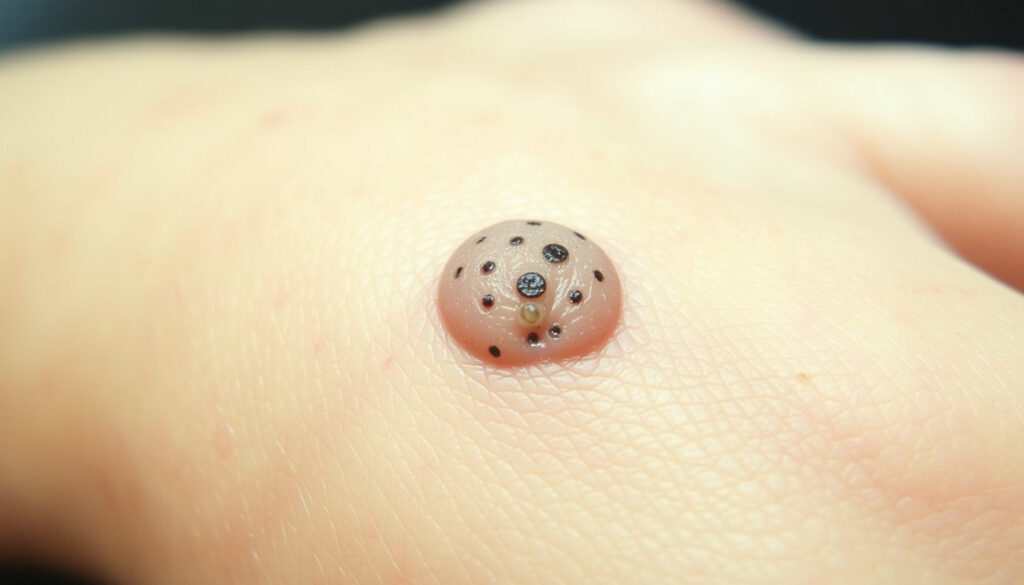
How to Identify a Wart: Visual Guide and Signs
You’re looking at a small bump on your hand or foot, and a single question is running through your mind: is this a wart? It’s a common moment of uncertainty, and for good reason — a half-dozen different skin growths can look nearly identical at first glance.
Percentage of people affected by warts: 10-20% of children, 3-5% of adults ·
Most common age group: Children and young adults (12-16 years) ·
HPV types responsible for common warts: HPV types 1, 2, 4, 27, 57 ·
Typical duration without treatment: 2-3 years for most warts; some resolve within 6 months
Quick snapshot
- Warts are caused by HPV infection of the top skin layer (Divine Dermatology (dermatology clinic))
- Common warts have a rough, cauliflower-like surface (HarlanMD (dermatology resource))
- Warts are contagious via direct contact (CDC (public health authority))
- Why some individuals are more susceptible to warts than others
- Whether warts have “roots” (they are superficial, not rooted in muscle)
- Exact duration of contagiousness after treatment
- Genital warts may appear weeks to months after HPV exposure (North Carolina Department of Health and Human Services (state health authority))
- Most cutaneous warts resolve within 2-3 years; some within 6 months (North Carolina Department of Health and Human Services (state health authority))
- Use the step-by-step identification guide below to check visual and tactile signs
- Consult a dermatologist if the growth is painful, bleeds, or changes shape
Five key facts, one pattern: the quickest way to tell a wart from other bumps is texture and location. Warts feel rough and appear on hands and feet; moles are smooth and pigmented; skin tags are soft flaps in skin folds. The table below lays out the differences side by side.
| Feature | Wart | Mole | Skin Tag | Corn / Callus |
|---|---|---|---|---|
| Texture | Rough, grainy, firm (Verywell Health (health resource)) | Smooth or slightly raised (Divine Dermatology (dermatology clinic)) | Soft, fleshy flap (Epiphany Dermatology (dermatology clinic)) | Hard, thick, flat |
| Shape | Irregular, dome-shaped, or cauliflower-like | Oval or round, symmetric (Divine Dermatology) | Pedunculated (stalk-like), balloon on a stick (Epiphany Dermatology) | Rounded or cone-shaped center |
| Color | Skin-toned, grayish, or brown; may have black dots (Verywell Health) | Tan, brown, or black; usually uniform | Flesh-colored or slightly darker | Yellowish or grayish |
| Pain | Usually painless unless on a pressure point (HarlanMD) | Painless | Painless | Painful on direct pressure |
| Common locations | Hands, fingers, feet, face (Verywell Health) | Anywhere on skin | Skin folds: neck, armpits, groin (Verywell Health) | Soles of feet, hands |
| Cause | HPV infection (Divine Dermatology) | Clusters of pigmented skin cells | Unknown; friction may play a role | Repeated pressure or friction |
How do you know if it’s a wart or not?
The most reliable approach combines visual inspection with touch. Here is a step-by-step method to identify a wart using three diagnostic domains: sight, feel, and location.
- Inspect visually — look for a rough, cauliflower-like surface, black dots (clotted capillaries), and skin-toned or grayish color.
- Feel the bump — run your finger over it; warts are firm and rough, unlike soft skin tags or smooth moles.
- Note the location — warts most often appear on hands, fingers, feet, and face; check if the bump matches these common sites.
Visual signs of a wart
- Rough, cauliflower-like surface — the hallmark of common warts (HarlanMD (dermatology resource))
- Black dots that look like tiny seeds — these are clotted capillaries (Verywell Health (health resource))
- Skin-toned, grayish, or brownish color; less pigmented than moles (Divine Dermatology (dermatology clinic))
- May appear as a dome-shaped bump or a flat, callus-like patch (plantar warts)
Tactile signs of a wart
- Firm and rough when you run a finger over it — skin tags are soft and smooth (Epiphany Dermatology (dermatology clinic))
- Grainy texture that distinguishes it from the smooth surface of a mole (Divine Dermatology)
- May feel raised or flat depending on type; plantar warts feel like a hard spot on the sole
Common locations for warts
- Hands and fingers — most common site for common warts (Verywell Health (health resource))
- Soles of the feet — plantar warts, often flat due to pressure (HarlanMD (dermatology resource))
- Face — flat warts and filiform warts (HarlanMD)
- Around fingernails or toenails — periungual warts (HarlanMD)
- Genital area — genital warts (CDC (public health authority))
Texture and location are your fastest diagnostic tools. A rough bump on a finger with black dots is almost certainly a common wart. A soft, stalk-like flap in the armpit is a skin tag — not a wart.
The implication: a bump that passes all three checks — rough texture, black dots, and typical location — is almost certainly a wart, while a bump that fails any check warrants a closer look at other possibilities.
What can be mistaken as warts?
There is no shortage of skin bumps that can trick the eye. The main impostors are moles, skin tags, corns, calluses, and skin cancers — each with distinct features that set them apart from warts.
Warts vs moles
- Moles are usually oval or round and symmetric, while warts have irregular shapes (Divine Dermatology (dermatology clinic))
- Moles are smooth or slightly raised; warts are rough and grainy (Divine Dermatology)
- Moles are pigmented in tans and browns; warts are usually skin-toned or lighter (Divine Dermatology)
- Moles lack the black dots (clotted capillaries) that are common in warts
Warts vs skin tags
- Skin tags are soft, fleshy flaps, while warts are firm and rough (Verywell Health (health resource))
- Skin tags have a narrow stalk (pedunculated), resembling a balloon on a stick (Epiphany Dermatology (dermatology clinic))
- Skin tags grow in skin folds (neck, armpits, groin) where skin rubs together (Verywell Health)
- A broad-based rough patch is more likely a wart than a skin tag (Epiphany Dermatology)
Warts vs corns and calluses
- Corns have a hard, cone-shaped center that is painful on direct pressure (HarlanMD (dermatology resource))
- Calluses are broad, flat, and painless; warts may have black dots inside
- Plantar warts grow inward under pressure, appearing flat like a callus but with dark spots (HarlanMD)
- The “pinch test”: squeezing a wart sideways causes pain; squeezing a corn directly does
Warts vs skin cancer
- Basal cell carcinoma (BCC) may appear as a pearly bump with visible blood vessels
- Squamous cell carcinoma (SCC) can be scaly, crusting, or bleeding — unlike warts
- Melanoma is asymmetrical, has irregular borders, and changes color (Divine Dermatology)
- A wart that bleeds, changes rapidly, or does not heal warrants an immediate dermatology consultation
Skin cancer mimics are the most serious differential. Any bump that bleeds, itches, scabs, or changes shape over weeks should be examined by a dermatologist — not treated at home as a wart.
What do HPV warts look like?
HPV — the human papillomavirus — causes more than 100 types of warts, each with a distinctive appearance depending on the strain and location. Here is how the five main subtypes present clinically.
Common warts
These are the classic warts you expect on hands: rough, dome-shaped, and grainy, often with black dots from thrombosed capillaries (HarlanMD (dermatology resource)). They are usually skin-colored or grayish and range from 1 mm to over 1 cm in diameter.
Plantar warts
Found on the soles of the feet, these grow inward because pressure flattens them into a callus-like plaque (HarlanMD). They are often painful when squeezed and may show black dots inside. Mosaic warts are clusters of small plantar warts on the heels or toes (HarlanMD).
Flat warts
Small, smooth, flat-topped lesions that appear in clusters, often on the face, legs, or back of hands (HarlanMD). They are flesh-colored, pink, or slightly brown and can be hard to spot individually due to their flat profile.
Filiform warts
Long, thread-like or finger-shaped projections that typically occur on the eyelids, lips, nose, or neck (HarlanMD). They grow quickly and are flesh-colored, resembling a thin stalk or projection.
Genital warts
Soft, flesh-colored bumps that may appear as a cauliflower-like cluster in the genital area (CDC (public health authority)). They are commonly caused by non-cancerous HPV types 6 or 11 and may appear weeks or months after sexual contact even if the partner has no visible signs (North Carolina Department of Health and Human Services (state health authority)).
Filiform warts look alarming with their finger-like projections, but they are benign and respond well to treatment. Meanwhile, flat warts — the most innocuous-looking — can be the hardest to treat because they often appear in large numbers and spread easily.
How to identify a wart on a finger?
Fingers are the prime real estate for common warts, but they also host other bumps that can cause confusion. Here is what to look for specifically on the hands and fingers.
Signs of a finger wart
- Rough, raised bump on the finger, often near the nail (HarlanMD (dermatology resource))
- Black dots visible on the surface (thrombosed capillaries)
- Skin-colored or grayish, not pigmented like a mole
- May cause nail deformity if located near the nail matrix (HarlanMD)
Finger wart vs other finger bumps
- Digital mucous cyst: a smooth, fluid-filled bump near the nail, not rough
- Heberden’s nodes: bony nodules on the last finger joint, hard and immovable
- Fibroma: firm, flesh-colored, but smooth — not rough like a wart
- Ganglion cyst: soft, fluctuant mass at the wrist or finger base, not superficial
When to see a doctor
- The bump is painful, bleeds, or changes rapidly
- You have diabetes, a weakened immune system, or poor circulation
- The wart does not respond to over-the-counter treatments after 8-12 weeks
- There are multiple warts or they are spreading quickly
The pattern: most finger warts are benign and self-limited, but any bump that bleeds or changes shape warrants a dermatologist’s exam to rule out squamous cell carcinoma, which can also present on the fingers. For related guidance on recognizing early warning signs, see our guide on Symptoms of Parkinson’s: 5 Early Signs, Finger Test & Home Check.
What is a wart?
A wart is a benign skin growth caused by infection of the top layer of skin with the human papillomavirus (HPV). The virus enters through small cuts or breaks in the skin and triggers rapid growth of keratin — the protein that makes skin tough — resulting in the characteristic rough texture (Divine Dermatology (dermatology clinic)).
Warts are contagious. They spread through direct skin-to-skin contact or indirectly through contaminated surfaces like gym floors or shared towels (CDC (public health authority)). Children and immunocompromised individuals are more susceptible because their immune systems are less effective at clearing the virus.
Many people believe warts have “roots” that extend deep into the skin. They don’t. Warts are superficial — the virus lives entirely in the epidermis. The black dots people mistake for roots are simply clotted capillary loops.
Most warts resolve spontaneously within two years, though some disappear within six months. The immune system eventually recognizes and clears the virus, which is why children outgrow warts more quickly than adults (CDC).
The implication: understanding that warts are a superficial viral infection rather than a deep-rooted growth changes how you approach treatment and prevention — topical therapies work because the virus stays in the top skin layer.
apdkc.com, bhskin.com, usdermatologypartners.com, bccdc.ca, peachdermatology.com, medicalnewstoday.com
Frequently asked questions
Can warts spread to other parts of the body?
Yes. Warts spread through direct contact or through contaminated objects like towels. Scratching or picking at a wart can transfer the virus to another area of skin.
Are warts painful?
Most warts are painless. However, plantar warts on the soles of the feet can cause pain when walking or standing, and warts on pressure points may also be tender.
Can I cut off a wart at home?
No. Cutting, burning, or picking at a wart can cause bleeding, infection, and scarring. It can also spread the virus to other areas. Always use approved treatments or see a dermatologist.
Do warts have roots?
No. Warts are superficial growths in the top layer of skin. The black dots often mistaken for roots are actually clotted capillary loops.
Are over-the-counter wart treatments effective?
Yes, for most common warts. Salicylic acid preparations (40%) are the first-line OTC treatment. Cryotherapy kits can also be effective. Success rates improve with consistent daily application.
How long does it take for a wart to go away?
Without treatment, most warts disappear within 2-3 years, though some resolve within 6 months. With consistent treatment, common warts may clear in 8-12 weeks.
Can warts be prevented?
Prevention focuses on avoiding exposure to HPV. Tips include wearing flip-flops in public showers, not sharing towels or razors, keeping cuts covered, and avoiding picking at warts.
What is the fastest way to get rid of a wart?
Dermatologist-administered treatments — cryotherapy, cantharidin, or laser therapy — offer the fastest results. In-office treatments can clear a wart in 1-3 sessions, depending on its size and location.
For anyone staring at an unfamiliar skin bump, the choice is clear: look for the rough texture, black dots, and common locations. If you find those, it’s likely a wart. If the bump is smooth, symmetrical, and pigmented, think mole. If it is soft and stalk-like, think skin tag. And if it bleeds or changes — call the dermatologist. For more on recognizing when skin changes warrant attention, see our guide on Why Are My Nipple Sore? Causes, Symptoms, and When to Worry.
More related posts
 How Many Weeks Is Pregnancy? 40 Weeks Guide & Calculator
 Chido Obi-Martin: Why He Left Arsenal, Man Utd Status
 How to Find an Eircode on a Map (Step-by-Step Guide)
 West Cork Film Studios: New Hollywood Hub in Ireland
 Best Beaches in Florida Gulf Coast: Top 10 & Family Guide
 Tottenham vs Fulham Stats: Head-to-Head, Predictions & Lineups
 Irish Racing Results Today Please | Kilbeggan Live Updates
 Mimosa Bar de Tapas – Build Your Own Brunch Spread