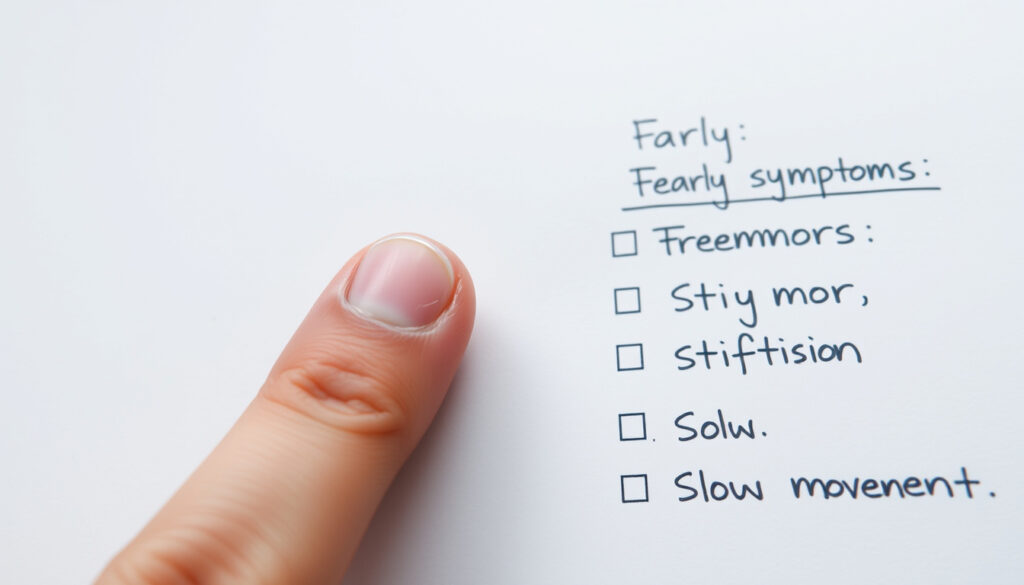
Symptoms of Parkinson’s: 5 Early Signs, Finger Test & Home Check
You’ve noticed a slight tremor in your hand, or maybe your handwriting has gotten smaller. These small changes often go unnoticed, but they can be early signs of Parkinson’s disease. A resting tremor in one hand is often the first noticeable symptom, according to the Mayo Clinic (leading academic medical center). This guide breaks down the five early signs, explains how the finger test works, and highlights conditions that are often mistaken for Parkinson’s.
Most common early motor symptom: tremor (Mayo Clinic) ·
Non-motor symptom: loss of smell (Parkinson’s Foundation) ·
Early non-motor sign: constipation (Parkinson’s Foundation)
Quick snapshot
- Parkinson’s involves loss of dopamine neurons in the substantia nigra (Mayo Clinic)
- Tremor, bradykinesia, rigidity, and postural instability are cardinal motor symptoms (Johns Hopkins Medicine)
- Loss of smell and REM sleep behavior disorder often precede motor symptoms (Parkinson’s Foundation)
- The exact cause of Parkinson’s is not fully understood (Mayo Clinic)
- Why some people develop early-onset (under 50) remains unknown (American Parkinson Disease Association)
- The role of environmental factors vs genetics is still under investigation (Johns Hopkins Medicine)
- Why some patients experience only non-motor symptoms for years isn’t clear (Parkinson’s Foundation)
- Symptoms start slowly and worsen over time (Mayo Clinic)
- Non-motor signs like loss of smell may appear years before motor symptoms (Parkinson’s Foundation)
- If you notice any early signs, see a neurologist — no lab test can confirm Parkinson’s (Johns Hopkins Medicine)
- The finger tap test and other bedside exams help assess motor function (Stanford Medicine 25)
The table below summarizes key facts about early Parkinson’s disease.
| Fact | Value |
|---|---|
| Most common early motor symptom | Tremor (Mayo Clinic) |
| Non-motor symptom that can appear years before motor signs | Loss of smell (Parkinson’s Foundation) |
| Early non-motor sign | Constipation (Parkinson’s Foundation) |
| Early motor sign | Small handwriting (micrographia) (Parkinson’s Foundation) |
| Cardinal motor symptoms | Tremor, bradykinesia, rigidity, postural instability (Johns Hopkins Medicine) |
What are the 5 early signs of Parkinson’s disease?
Tremor
- A slight shaking in a finger, thumb, hand, or chin while at rest is often the first noticeable sign (Mayo Clinic).
- The tremor typically appears in one hand before spreading to the other side (Parkinson’s Foundation).
Small handwriting
- Writing becomes smaller and more cramped — a condition called micrographia (Parkinson’s Foundation).
- Letters may drift closer together, and it becomes harder to write legibly (American Parkinson Disease Association).
Loss of smell
- Reduced ability to smell (anosmia) often appears years before motor symptoms (Parkinson’s Foundation).
- It may affect the ability to enjoy food or detect odors like coffee or flowers (Johns Hopkins Medicine).
Trouble sleeping
- REM sleep behavior disorder — acting out dreams with kicking, punching, or shouting — is a common early sign (Parkinson’s Foundation).
- Restless legs and frequent nighttime awakenings also occur (American Parkinson Disease Association).
Trouble moving or walking
- Stiffness in one arm or leg, a feeling of heaviness, or a subtle drag in one leg can be early bradykinesia (Johns Hopkins Medicine).
- Movements become slower and less coordinated over time (Mayo Clinic).
Bradykinesia is the hallmark symptom of Parkinson’s disease — it’s not just slowness, it’s a decrease in the amplitude and speed of repetitive movements (Stanford Neurologist).
The implication: noticing any of these five signs warrants a conversation with a doctor, as early intervention can slow progression.
What is the finger test for Parkinson’s?
How the finger tap test works
- The patient taps the thumb and index finger together as quickly and as wide as possible, 10–15 times (Stanford Medicine 25).
- The clinician tests both the right and left sides and looks for a reduction in speed and amplitude (Stanford Medicine 25).
What results indicate Parkinson’s
- A slowing or decreasing amplitude of the taps (called “fatigue” or “decrement”) suggests bradykinesia (Stanford Medicine 25).
- This test is part of the Unified Parkinson’s Disease Rating Scale (UPDRS) and helps quantify motor impairment (Johns Hopkins Medicine).
Limitations of the finger test
- The finger tap test alone cannot diagnose Parkinson’s — it must be combined with other exams (toe tapping, gait assessment, tremor observation) (Stanford Medicine 25).
- Results can be affected by arthritis, hand injury, or fatigue (American Parkinson Disease Association).
What is often mistaken for Parkinson’s?
Essential tremor
- The most common condition confused with Parkinson’s — it causes a rhythmic shaking, usually in both hands, but with no bradykinesia or rigidity (Johns Hopkins Medicine).
- The tremor is an “action tremor” (during movement) rather than a resting tremor (Mayo Clinic).
Multiple system atrophy (MSA)
- A Parkinson-plus syndrome that includes autonomic dysfunction (blood pressure, bladder problems) (Parkinson’s Foundation).
- MSA progresses more rapidly and responds poorly to levodopa (Johns Hopkins Medicine).
Progressive supranuclear palsy (PSP)
- Another Parkinson-plus syndrome, marked by early falls and difficulty moving the eyes up and down (Mayo Clinic).
- Unlike Parkinson’s, PSP often causes a stiff, extended posture and backward leaning (American Parkinson Disease Association).
Drug-induced parkinsonism
- Antipsychotics, anti-nausea drugs, and some calcium channel blockers can cause Parkinson-like symptoms (Johns Hopkins Medicine).
- These symptoms are often reversible once the medication is stopped (Parkinson’s Foundation).
Vascular parkinsonism
- Caused by small strokes in the brain’s motor regions, leading to a shuffling gait and lower-body stiffness (Mayo Clinic).
- It does not usually involve a resting tremor, and symptoms are more sudden in onset (Johns Hopkins Medicine).
Many conditions mimic Parkinson’s, but the combination of resting tremor, bradykinesia, rigidity, and a good response to levodopa strongly points to idiopathic Parkinson’s disease (Johns Hopkins Medicine).
What is stage 1 of Parkinson’s disease?
Symptoms in stage 1
- Stage 1 is the mildest form — symptoms are unilateral (affecting only one side of the body) (Parkinson’s Foundation).
- Tremor, rigidity, or bradykinesia may be present but do not interfere significantly with daily activities (Mayo Clinic).
Impact on daily life
- People can still work, drive, and perform most tasks independently (American Parkinson Disease Association).
- Family and friends may not notice any changes, though subtle signs like a softer voice or reduced arm swing on one side can be present (Parkinson’s Foundation).
Progression to stage 2
- As the disease progresses, symptoms spread to both sides of the body, and balance difficulties may begin (Johns Hopkins Medicine).
- Treatment with levodopa or other medications can help manage symptoms and delay progression (Mayo Clinic).
Stage 1 is the best window for early intervention. Recognizing symptoms at this stage can give patients years of good quality of life with appropriate treatment (Parkinson’s Foundation).
How to check for Parkinson’s at home?
Self-observation of early signs
- Watch for a resting tremor, especially in one hand or finger (Parkinson’s Foundation).
- Check your handwriting — has it become smaller or more cramped? (Parkinson’s Foundation)
- Notice if you have lost your sense of smell or have trouble smelling familiar odors (American Parkinson Disease Association).
- Pay attention to sleep — do you act out your dreams or kick/punch in your sleep? (Parkinson’s Foundation)
Using the finger tap test at home
- Sit comfortably and tap your thumb and index finger together as rapidly and widely as possible for 10–15 seconds (Stanford Medicine 25).
- Repeat on the other hand. Notice if one side is slower or if the taps get smaller and slower over the 10 seconds (Stanford Medicine 25).
When to see a doctor
- No home test can diagnose Parkinson’s — these checks are only prompts to seek professional evaluation (Johns Hopkins Medicine).
- If you notice any of the early signs, schedule an appointment with a neurologist, ideally a movement disorder specialist (Parkinson’s Foundation).
While home checks can raise awareness, relying on them instead of a medical exam can delay diagnosis. Catching Parkinson’s early gives you the longest possible runway for effective treatment (Johns Hopkins Medicine).
Confirmed facts
- Parkinson’s disease involves loss of dopamine-producing neurons in the substantia nigra (Mayo Clinic).
- Tremor, bradykinesia, rigidity, and postural instability are cardinal motor symptoms (Johns Hopkins Medicine).
- Non-motor symptoms like loss of smell and REM sleep behavior disorder often precede motor symptoms (Parkinson’s Foundation).
- The finger tap test is a validated part of the UPDRS assessment (Stanford Medicine 25).
What’s unclear
- The exact cause of Parkinson’s disease is not fully understood (Mayo Clinic).
- Why some people develop early-onset Parkinson’s (under 50) is not known (American Parkinson Disease Association).
- The role of environmental factors versus genetics remains under investigation (Johns Hopkins Medicine).
- Why some patients experience only non-motor symptoms for years is not clear (Parkinson’s Foundation).
“Parkinson’s disease often begins with a barely noticeable tremor in one hand, sometimes a foot or jaw, and the tremor is typically a resting tremor.” — Mayo Clinic
“The Parkinson’s Foundation lists a slight shaking or tremor in a finger, thumb, hand, or chin while at rest as an early sign.” — Parkinson’s Foundation
“Bradykinesia is the hallmark symptom of Parkinson’s disease.” — Stanford Neurologist
“There is no lab or imaging test that is recommended or definitive for Parkinson’s disease.” — Johns Hopkins Medicine
For anyone noticing small changes in their hand or gait, the decision to see a neurologist early is what separates years of subtle progression from a delayed diagnosis that can complicate treatment. With over 10 million people living with Parkinson’s worldwide, understanding the earliest signs — and knowing what to ask a doctor — is the most powerful tool you have. The implication for people in their 50s and 60s is clear: trust your instincts, try the finger tap test, and if something feels off, push for a specialist referral — because a few months of earlier treatment can make a measurable difference in quality of life.
A detailed look at Parkinsons disease symptoms and stages provides further context on how these symptoms develop over time.
Frequently asked questions
What are two new early signs of Parkinson’s?
Recent research highlights loss of smell (anosmia) and REM sleep behavior disorder as two early non-motor signs that can appear years before motor symptoms (Parkinson’s Foundation).
What is the sister disease to Parkinson’s?
Multiple system atrophy (MSA) is sometimes called “Parkinson’s plus” because it shares many motor symptoms but also includes autonomic dysfunction and a more rapid progression (Johns Hopkins Medicine).
What are the worst symptoms of Parkinson’s disease?
Advanced symptoms include severe freezing of gait, falls, difficulty swallowing, and cognitive decline — these typically emerge in later stages and require comprehensive management (Mayo Clinic).
What causes Parkinson’s disease?
The exact cause is unknown, but it involves a combination of genetic predisposition and environmental triggers that lead to the loss of dopamine-producing neurons in the substantia nigra (Johns Hopkins Medicine).
How is Parkinson’s disease treated?
Treatment includes medications (levodopa, dopamine agonists), physical therapy, lifestyle changes, and in advanced cases, deep brain stimulation. There is no cure, but early treatment improves quality of life (Mayo Clinic).
What are early symptoms of Parkinson’s in females?
Women may experience more prominent tremor and less rigidity than men, and they are more likely to have anxiety and depression as early non-motor symptoms (Parkinson’s Foundation).
More related posts
 South Africa Rugby Team – Springboks Guide
 BBC Fixtures and Results: Today’s Football Scores & TV Schedule
 Nvidia Share Price Today: Buy, Sell, or Hold? | NVDA Analysis
 Fear and Greed Index: What It Is and How to Use It in Trading
 Osso Buco Near Me: Best Places to Buy & Eat in Ireland (2025)
 Galaxy Z Fold4 to Buy: Best Deals and Buying Guide
 What Causes Poor Sleep Quality—and How to Fix It
 100 Euro to Dollar – Current Rate and Key Insights