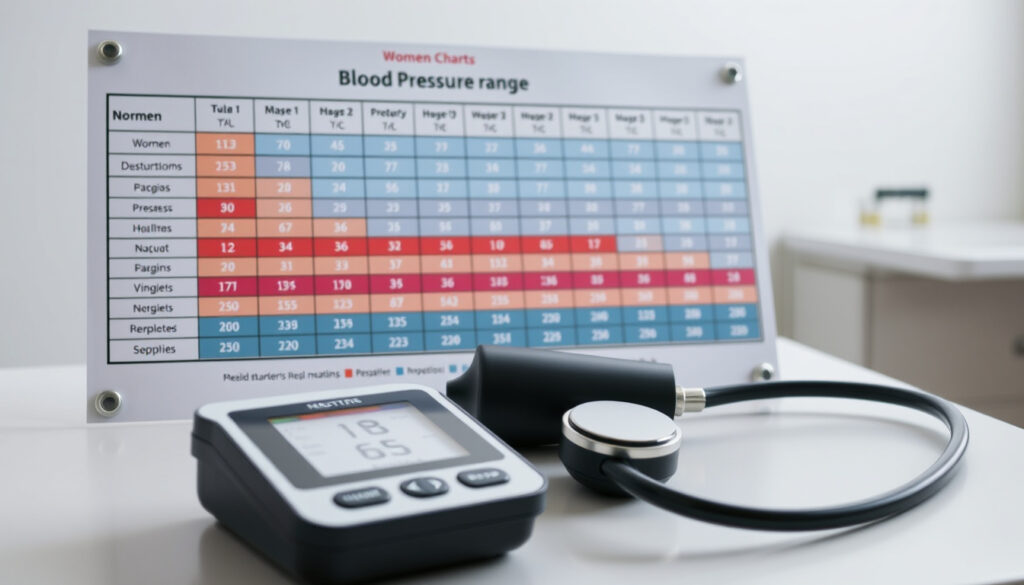
What Is a Normal Blood Pressure for a Woman? Chart
If your blood pressure readings feel like a confusing string of numbers, you are not alone. Most women know that 120/80 matters, but how that number shifts with age — and when it signals real danger — is far less understood. This guide connects the American Heart Association’s official categories with age-specific averages from major health centers, so you can quickly see where your reading lands and what to do about it.
Normal blood pressure for women: Less than 120/80 mm Hg (American Heart Association) ·
Average BP for women 18–39: 110/68 mm Hg (Baptist Health) ·
Stage 1 hypertension: 130–139/80–89 mm Hg (AHA) ·
Ideal BP per Irish Heart: Less than 120/70 mm Hg ·
Hypertension prevalence in women: Approximately 1 in 3 women develop high blood pressure (CDC)
Quick snapshot
- Normal BP for women is less than 120/80 mm Hg (American Heart Association)
- The exact blood pressure threshold that triggers a “mini-stroke” varies by individual
- Average BP rises with age — women 18–39 average 110/68, women 60+ average 139/68 (Baptist Health)
- Monitor readings regularly and consult a doctor if BP crosses 130/80 or falls below 90/60 with symptoms
A quick frame for six common BP categories, all sourced from the American Heart Association (national heart-health authority) and the Cleveland Clinic (major U.S. medical center).
| Category | Systolic (mm Hg) | Diastolic (mm Hg) |
|---|---|---|
| Normal BP (AHA) | <120 | <80 |
| Elevated BP | 120–129 | <80 |
| Stage 1 Hypertension | 130–139 | 80–89 |
| Stage 2 Hypertension | ≥140 | ≥90 |
| Hypertensive Crisis | >180 | >120 |
| Low Blood Pressure | <90 | <60 |
The pattern: Five of the six categories are defined by the AHA’s 2017 guidelines, while the low-BP threshold comes from the Cleveland Clinic — and the contrast matters. Normal and low are separated by a gap of 30 systolic points; once you cross 180 systolic, the stakes change from “monitor” to “call 911.”
What is normal blood pressure for a woman by age?
Normal vs. elevated readings
The AHA’s definition of normal — less than 120/80 mm Hg — applies to all adults, but age and sex shift the averages. For women ages 18 to 39, the average reading is 110/68 mm Hg, according to data from Baptist Health (regional hospital system). That number climbs: women 40 to 59 average 122/74, and women 60 and older average 139/68. The Irish Heart Foundation (national cardiovascular charity) sets an even tighter ideal at less than 120/70 mm Hg.
Blood pressure chart for women 18–39, 40–59, 60+
Four age bands, one clear trend: systolic pressure rises steadily through adulthood while diastolic plateaus after 60. The Cardilog (digital health platform) provides a more granular breakdown: women 18–24 average 110/68, women 25–29 average 112/70, women 30–39 average 116/72, women 40–49 average 122/76, women 50–59 average 128/80, women 60–69 average 134/78, women 70–79 average 139/74, and women 80+ average 143/72. The MedicineNet (clinical reference site) data echoes this: women 21–25 average 115.5/70.5, women 31–35 average 110.5/72.5, and women 46–50 average 124/78.5.
The implication: age-related increases in systolic pressure do not mean you should accept readings above 120/80. The AHA target remains the benchmark regardless of decade.
A 38-year-old woman with a reading of 118/76 is in the normal range. A 58-year-old woman with the same number is also normal — but she is 6 points lower than the average for her age group, which suggests her heart health habits are working.
What is dangerously high blood pressure for a woman?
Hypertension stages explained
The AHA divides elevated readings into three stages. Stage 1 hypertension: systolic 130–139 or diastolic 80–89. Stage 2: systolic 140 or higher, or diastolic 90 or higher. A reading of 150/80 puts you in stage 2 — the AHA says this warrants a doctor visit and likely medication. A reading of 140/90 is also stage 2 but may not require an ER trip unless you have symptoms like headache, shortness of breath, or chest pain.
When to seek emergency care
A hypertensive crisis — systolic over 180 and/or diastolic over 120 — requires immediate medical attention, especially if accompanied by symptoms. The American Heart Association (national cardiac authority) is clear: “If your blood pressure is higher than 180/120 mm Hg and you are experiencing symptoms… wait five minutes and test again. If readings are still higher than 180/120 mm Hg, call 911.”
A woman with a hypertensive crisis faces a 2- to 4-fold increased risk of stroke within the next 12 months, because sustained pressure above 180 systolic damages artery walls at a rate that can outpace the body’s repair mechanisms.
What is a dangerous low blood pressure for a woman?
Symptoms of hypotension
The Cleveland Clinic (major U.S. medical center) defines low blood pressure as below 90/60 mm Hg. For many women, especially younger ones, a reading of 88/55 may feel fine. The danger arrives when symptoms do: dizziness, fainting, blurred vision, nausea, or fatigue. These can signal that organs are not getting enough blood flow.
When low BP becomes an emergency
Severe hypotension can lead to shock — cold, clammy skin, rapid shallow breathing, weak pulse. The National Heart, Lung, and Blood Institute (federal research agency) notes that pregnancy, dehydration, and certain medications (especially diuretics) increase a woman’s risk. If low BP is accompanied by confusion, chest pain, or loss of consciousness, call 911 immediately.
Younger women with naturally low BP (around 90/60) have a lower lifetime risk of heart disease — but if they become dehydrated, they may faint more easily than someone with a 120/80 baseline. The trade-off is real but manageable with hydration awareness.
The pattern: low BP is protective only when symptom-free. Once dizziness or fainting appears, the same reading turns from asset to liability.
What brings blood pressure down the fastest?
Lifestyle changes for immediate effect
Deep breathing can lower systolic pressure by 10–15 mm Hg within minutes, according to the University of Utah Health (academic medical center). Reducing sodium — cutting out one high-salt meal — can show effects within hours. Drinking water helps if dehydration is the cause, but water alone does not treat chronic hypertension.
Medication options
The fastest safe reduction for acutely high BP comes from prescribed antihypertensives — typically a calcium channel blocker or ACE inhibitor, which can lower pressure within 30–60 minutes under medical supervision. The FDA (U.S. drug regulator) warns against using over-the-counter supplements for acute high BP, as their effects are unpredictable.
Can drinking lots of water lower blood pressure?
Hydration and blood volume
Adequate hydration keeps blood volume stable, which helps maintain normal pressure. The WomenHeart (national advocacy group for women with heart disease) notes that dehydration can raise BP because the body constricts blood vessels to conserve fluid. But drinking extra water beyond normal hydration does not further lower BP — it simply maintains the status quo.
Water’s effect on sodium balance
Water helps the kidneys flush sodium, which can reduce blood volume and lower pressure over time. However, the American Heart Association (national heart-health authority) says the effect is modest — about 2–3 mm Hg systolic reduction for a person who goes from dehydrated to hydrated. Drinking gallons of water will not replace medication or a low-sodium diet.
What are the warning signs of a mini stroke?
FAST acronym
The American Stroke Association (division of the AHA) uses FAST: Face drooping, Arm weakness, Speech difficulty, Time to call 911. Additional signs for women include sudden numbness on one side, confusion, trouble seeing, or a severe headache with no known cause. High blood pressure is the single biggest risk factor for transient ischemic attack (TIA) — a mini-stroke that often precedes a full stroke.
Relationship between high BP and TIA
A TIA occurs when a blood clot temporarily blocks an artery to the brain. The CDC (U.S. federal public health agency) states that women with hypertension have a 1.8 times higher risk of TIA compared to women with normal BP. Even a single TIA increases the risk of a major stroke within the next 90 days — which is why recognizing the FAST signs matters.
“If you experience any one of these symptoms, even if it goes away, call 911 immediately. Do not drive yourself to the hospital.”
— American Stroke Association stroke warning guideline on high-BP-related TIA risk
“Women often have unique stroke symptoms, such as sudden hiccups or nausea, that can be mistaken for other conditions. High BP amplifies those symptoms.”
— WomenHeart (national advocacy group) on sex-specific stroke signs
“The average blood pressure reading for a woman in her 40s is 122/74, but that ‘average’ includes many women who are already in the elevated or stage 1 range. Do not compare yourself to the average — compare yourself to the guideline.”
— Baptist Health (regional hospital system) on interpreting BP charts
“Unless your BP is over 180/120, the fastest safe way to lower it is NOT a glass of water or a deep breath — it’s taking your prescribed medication exactly as directed.”
— University of Utah Health (academic medical center) on acute BP management
The consequence is straightforward: for women managing blood pressure, the gap between a manageable number and a dangerous one is narrower than most realize. A 58-year-old woman who sees 140/90 on the monitor and dismisses it as “normal aging” is gambling with a 1.8× increased TIA risk. The choice is clear: measure monthly after 40, act on any reading above 130/80, and treat 180/120 as a 911 event — because the 90-day window after a TIA is when prevention matters most.
Frequently asked questions
What is stroke level blood pressure?
The AHA defines stroke-level BP as a hypertensive crisis — systolic over 180 and/or diastolic over 120. This level of pressure can damage artery walls and trigger a clot or bleed in the brain.
Should I worry if my blood pressure is 150/80?
Yes — 150/80 is stage 2 hypertension (systolic ≥140). You should see a doctor within a week to discuss medication and lifestyle changes.
Should I go to the hospital if my blood pressure is 140 over 90?
Not necessarily — 140/90 is stage 2 hypertension but usually does not require emergency care unless accompanied by symptoms like chest pain, headache, or shortness of breath. See a primary care doctor soon.
What is a normal blood pressure for a man?
The same AHA guideline applies: less than 120/80 mm Hg. Men tend to have slightly higher average BP than women until age 60, after which the gap narrows.
What is normal blood pressure for adults?
The AHA defines normal BP for all adults as systolic less than 120 mm Hg and diastolic less than 80 mm Hg.
Is 120/80 always normal for women?
120/80 is at the top of the normal range — the AHA calls it “normal.” But the Irish Heart Foundation sets a stricter ideal of less than 120/70. For most women, 120/80 is fine as long as it does not climb higher.
Can stress cause high blood pressure in women?
Yes — acute stress raises BP temporarily via adrenaline release. Chronic stress can contribute to sustained hypertension, especially in women who have caregiving responsibilities or work-high-pressure jobs.
Related reading: Pins and Needles in Feet: Causes, Warning Signs, Relief · Symptoms of Parkinson’s: 5 Early Signs, Finger Test & Home Check
More related posts
 Liverpool Transfer News: Isak Signs British-Record £125m Deal
 Woodies Wexford Opening Hours – Weekday Weekend and Holiday Schedule
 Hotels in Kilkenny City: The Best Places to Stay in 2025
 Nvidia Share Price Today: Buy, Sell, or Hold? | NVDA Analysis
 Brendan Gleeson Movies and TV Shows: Complete Guide
 Disability Clothing Allowance Ireland: What You Can Claim in 2026
 Weather in London 10 Days: Forecast & Storm Updates
 Hyde Park Winter Wonderland 2026: Tickets, Dates & Cost