How to Say the Rosary: Step-by-Step Guide for Beginners
There’s a quiet, almost meditative rhythm to the rosary that has drawn Catholics to its beads for centuries. But if you’ve never prayed one before, the sequence of prayers and mysteries can feel like a code you need to crack.
Rosary beads in a standard set: 59 beads (5 decades) ·
Main prayers recited: Apostles’ Creed, Our Father, Hail Mary, Glory Be, Salve Regina ·
Mystery sets: 4: Joyful, Sorrowful, Glorious, Luminous ·
Total Hail Marys in a full rosary: 53 ·
Year the Rosary was formally approved by the Church: 1569 (Pope Pius V)
Quick snapshot
- The Rosary consists of five decades, each with one Our Father, ten Hail Marys, and one Glory Be (USCCB official rosary guide).
- Prayers open with the Sign of the Cross and the Apostles’ Creed on the crucifix (The Holy See).
- Four sets of mysteries are prayed on different days (Ascension Press).
- Pope Pius V standardized the current form in 1569 (Catholic Answers tract).
- Whether St. Dominic actually received the Rosary from the Virgin Mary — the legend emerged later and historical documentation is sparse.
- The exact origin of the term “rosary” (from Latin rosarium meaning “rose garden”) is debated among scholars.
- 13th century: Legend attributes the Rosary’s origin to St. Dominic. (Catholic Answers tract)
- 1569: Pope Pius V issued Consueverunt Romani Pontifices, standardizing the Rosary (Catholic Answers tract).
- 2002: Pope John Paul II added the Luminous Mysteries (Vatican News).
- New Catholics and returning faithful will find updated digital resources from the USCCB official rosary guide and Rosary Center that mirror the sequence taught in parishes.
- Continue watching for local variations, especially the Irish family rosary tradition that adds special prayers. (USCCB official rosary guide)
The pattern across all official sources is consistent: the rosary anchors its prayers in the life of Christ through structured meditation.
| Label | Value |
|---|---|
| Rosary name origin | From Latin rosarium meaning “rose garden” or “garland of roses” |
| Pope who approved the current form | Pope Pius V in 1569 (Catholic Answers tract) |
| Luminous Mysteries added by | Pope John Paul II in 2002 (Vatican News) |
| Feast of Our Lady of the Rosary | October 7 |
How do you say the Rosary step by step?
The sequence is remarkably consistent across all official Catholic sources. The USCCB, Vatican, and Rosary Center all teach the same opening pattern: begin with the crucifix, recite the Apostles’ Creed, then move through the beads in a set rhythm.
Starting the Rosary: Sign of the Cross and Apostles’ Creed
- Make the Sign of the Cross while holding the crucifix. The USCCB instructs: “In the name of the Father, and of the Son, and of the Holy Spirit. Amen.” (USCCB official rosary guide)
- Recite the Apostles’ Creed on the crucifix. This is the profession of faith that opens every rosary. (The Holy See)
- On the first bead pray one Our Father, on the next three beads pray three Hail Marys, then finish with a Glory Be on the next bead. Each of these prayers is said aloud or silently. (Catholic Answers tract)
The implication: these opening prayers aren’t optional — they set the intention for the entire meditation.
The five decades: Our Father, Hail Mary, Glory Be
- Each decade consists of one Our Father (the large bead), ten Hail Marys (the small beads), and one Glory Be. (USCCB official rosary guide)
- Before each decade, announce the mystery you will meditate on. For example: “The first Joyful Mystery is the Annunciation.” (Rosary Center & Confraternity)
- After each decade, you may pray the Fatima Prayer: “O my Jesus, forgive us our sins, save us from the fires of hell…” This is a popular addition but not required. (CatholiCity prayer guide)
- Complete five decades, then conclude with the Hail Holy Queen and a final Sign of the Cross. (Catholic Answers tract)
The pattern: the rosary isn’t a free-form prayer — it’s a structured meditation that repeats the same core prayers, each tied to a specific mystery. The repetition is intentional, creating a rhythm that quiets the mind and focuses the heart.
How do you announce the 5 mysteries of the Rosary?
Announcing the mystery before each decade is the bridge between vocal prayer and meditation. The USCCB and Rosary Center both emphasize that the mystery name sets the scene for reflection.
Joyful Mysteries (Mondays and Saturdays)
- The Annunciation — “The Angel Gabriel announces to Mary that she will conceive Jesus.” (Vatican News)
- The Visitation — “Mary visits her cousin Elizabeth.” (Rosary Center)
- The Nativity — “The birth of Jesus in Bethlehem.”
- The Presentation — “Mary and Joseph present Jesus in the Temple.”
- The Finding in the Temple — “Jesus is found teaching in the Temple.”
Sorrowful Mysteries (Tuesdays and Fridays)
- The Agony in the Garden — “Jesus prays in Gethsemane.”
- The Scourging at the Pillar — “Jesus is whipped.”
- The Crowning with Thorns — “Soldiers mock Jesus with a crown of thorns.”
- The Carrying of the Cross — “Jesus carries his cross to Calvary.”
- The Crucifixion — “Jesus dies on the cross.” (Ascension Press)
Glorious Mysteries (Wednesdays and Sundays)
- The Resurrection — “Jesus rises from the dead.”
- The Ascension — “Jesus ascends to heaven.”
- The Descent of the Holy Spirit — “The Holy Spirit comes upon the Apostles.”
- The Assumption — “Mary is taken body and soul into heaven.”
- The Coronation — “Mary is crowned Queen of Heaven.” (Catholic Online prayer page)
Luminous Mysteries (Thursdays)
- The Baptism of Jesus in the Jordan.
- The Wedding at Cana.
- The Proclamation of the Kingdom.
- The Transfiguration.
- The Institution of the Eucharist. (The Holy See)
The catch: Many Catholics find the Luminous Mysteries unfamiliar because they were added only in 2002 by Pope John Paul II. But the schedule is now standard across the universal Church.
The mysteries give the rosary its depth. Without them, the prayers would be empty repetition. Each decade becomes a walking meditation through a key scene of the Gospel, and the day of the week ensures you cycle through the entire life of Christ and Mary in a regular rhythm.
How do you say the Rosary in Ireland?
The Irish rosary tradition adds a familial warmth to the standard structure. In many Irish homes, the family gathers in the evening to pray together, often adding a few extra prayers that aren’t found in official Vatican guides.
Irish family rosary tradition
- The rosary is often led by the head of the household, with all members responding aloud. (CatholiCity prayer guide)
- Many families add the “Prayer to St. Michael” (composed by Pope Leo XIII) after each decade, a practice that became popular after a reported vision. (Catholic Answers tract)
- The Fatima Prayer (“O my Jesus…”) is also commonly inserted after each Glory Be, as famously requested by the Virgin Mary in 1917. (Catholic Online prayer page)
- The basic prayers and structure remain the same as the standard Catholic rosary — only the additions vary. (Rosary Center)
The trade-off: The additions enrich the prayer but can be overwhelming for newcomers. If you’re just starting, stick with the core prayers listed by the USCCB. Once you’re comfortable, consider adding the Fatima Prayer and St. Michael Prayer.
How to pray the Rosary for beginners?
If you’ve never prayed a rosary before, the best approach is to start small and use a guide. The USCCB recommends memorizing the six basic prayers first: Sign of the Cross, Apostles’ Creed, Our Father, Hail Mary, Glory Be, and Hail Holy Queen.
Printable rosary guide for beginners
- The USCCB provides a full step-by-step guide that you can bookmark on your phone. (USCCB official rosary guide)
- The Rosary Center offers a printable PDF with all prayers and mystery prompts. (Rosary Center & Confraternity)
- Catholic Answers has a simple one-pager that covers the entire sequence. (Catholic Answers tract)
Common mistakes to avoid
- Rushing through the prayers without pausing to reflect on the mystery.
- Forgetting to announce the mystery before each decade — the meditation is the entire point.
- Praying only one decade and expecting the full grace of the rosary — the Church recommends all five decades for a complete rosary.
Understanding the beads
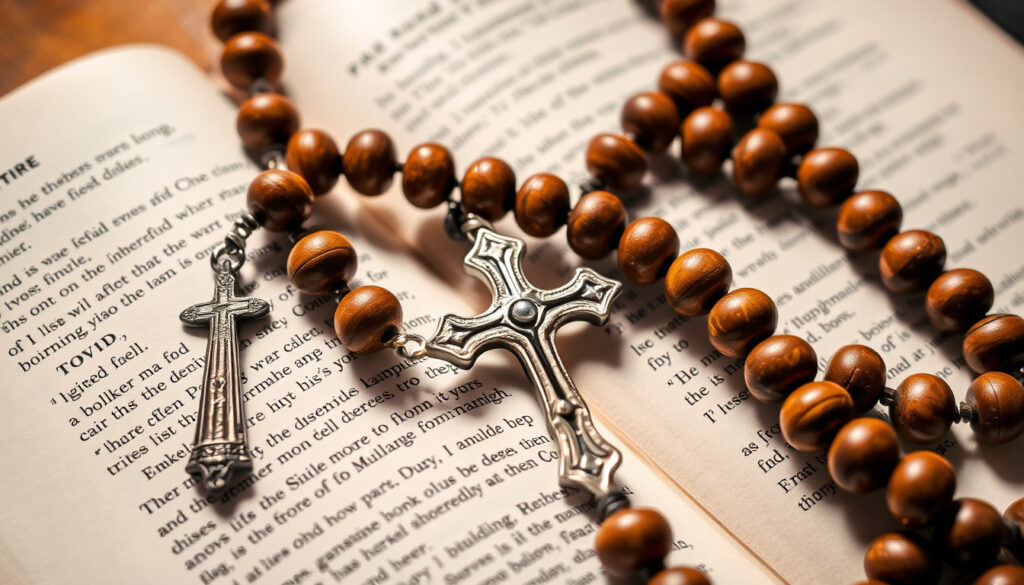
- The crucifix is used for the opening prayers (Sign of the Cross and Apostles’ Creed).
- The first large bead after the crucifix is for the “Our Father.”
- Three small beads follow for three “Hail Marys” (to increase faith, hope, and charity).
- A single large bead for the “Glory Be.”
- Then each decade: one large bead (Our Father), ten small beads (Hail Marys), one large bead (Glory Be). Repeat for five decades.
- The centerpiece medal and the remaining beads after the fifth decade lead to the concluding prayers.
The implication: for anyone new to the rosary, the advice is clear — practice one decade daily for a week, then add a second. Within a month you’ll know the entire sequence by heart.
Many beginners assume they need the physical beads. While beads are helpful for counting, you can pray the rosary using your fingers or a simple tally. The Church permits prayer without beads — the prayers and meditations are what matter.
What should Catholics do before bed?
Evening prayer is a longstanding Catholic tradition. The USCCB suggests examining your conscience and saying a few prayers before sleep — and the rosary fits naturally into that routine.
Examination of conscience
The USCCB recommends a brief examination of conscience each evening: recall the day’s actions, give thanks for blessings, and ask forgiveness for failings. This prepares the heart for a peaceful night. (USCCB official rosary guide)
Bedtime prayers including the Rosary
Many Catholics pray a single decade of the rosary before bed, focusing on the Sorrowful Mysteries on Fridays or simply the prayer that brings them comfort. The Guardian Angel prayer is a common addition: “Angel of God, my guardian dear, to whom God’s love commits me here.” (Catholic Answers tract)
The pattern: bedtime rosary practice is low-key by design — no need to complete all five decades if you’re tired. Even one decade, prayed slowly and reflectively, can be a powerful end to the day.
“The Rosary is a Scripture-based prayer that combines vocal prayer and meditation.”
— USCCB official rosary guide
“The Rosary has 20 mysteries in total — Joyful, Sorrowful, Glorious, and Luminous — each inviting you to meditate on key events in the life of Christ and Mary.”
— Ascension Press, Catholic publisher
“The decade pattern of one Our Father, ten Hail Marys, and one Glory Be is universal across all official rosary guides.”
— Rosary Center & Confraternity
For anyone seeking to learn how to say the rosary, the path is clear: begin with the opening prayers on the crucifix, move bead by bead through five decades, and close with the Hail Holy Queen. The USCCB, Vatican, and Rosary Center all agree on the sequence, so you can trust that you’re praying as the Church intends. For the beginner in Ireland or the United States, the choice is simple: pick a guide, learn the six core prayers, and start with one decade tonight. Tomorrow, add the second.
corpus.wa.edu.au, ascensionpress.com, hallow.com, catholicwoodworker.com
For a clear and concise guide for praying the Rosary, this step-by-step approach breaks down each prayer and decade for beginners.
Frequently asked questions
What is the correct way to hold the rosary beads?
Hold the crucifix at the start of the rosary. As you move through the prayers, let the beads rest between your thumb and index finger, sliding one bead at a time as you pray. There’s no strict hand position — the focus is on the prayer, not the grip.
Can you pray the Rosary without beads?
Yes. The Church permits praying the rosary without physical beads. You can count on your fingers, use a mental tally, or use a rosary app. The prayers and meditations are what matter, not the object.
How long does it take to pray the Rosary?
A full rosary (five decades) typically takes 15–20 minutes when prayed at a conversational pace. A single decade takes about 3–4 minutes. Newcomers often take longer as they learn the prayers.
Is the Rosary only for Catholics?
The rosary is primarily a Catholic devotion, but Christians of other denominations sometimes pray it as well. The prayers are drawn from Scripture and the early Church, so they are accessible to any believer who honors Jesus and Mary.
What is the significance of the crucifix on the rosary?
The crucifix reminds us of Jesus’ sacrifice. The rosary begins with the Sign of the Cross and the Apostles’ Creed on the crucifix, grounding the prayer in the central mystery of faith: the cross and resurrection.
How often should Catholics pray the Rosary?
The Church does not require a specific frequency. Many Catholics pray it daily, especially during October (the month of the Rosary) or on Saturdays dedicated to Mary. The USCCB encourages regular prayer but leaves the frequency to each person’s devotion.
Can I pray the Rosary for a specific intention?
Absolutely. You can offer the entire rosary or each decade for a particular intention — for healing, for peace, for a loved one, or for any need. It’s a common practice to mention the intention before each decade.
More related posts
 Best Soups for Winter: Classics and Diabetic Picks
 Summer French Tip Nail Designs: Simple, Acrylic & Colorful
 Arnold Palmer Invitational Prize Money 2026: Payouts & Bhatia $4M Win
 How Long Is a Half Marathon? Distance, Time & Key Facts
 How to Scan Documents to PDF: Phone, Printer & Free Apps
 Daily Mail Showbiz News: Latest Celebrity Gossip & Analysis
 Convert YouTube to MP3: Free, Safe & Legal Methods (2026 Guide)
 Rugby Today Time Kick Off Times: Fixtures & TV Schedule