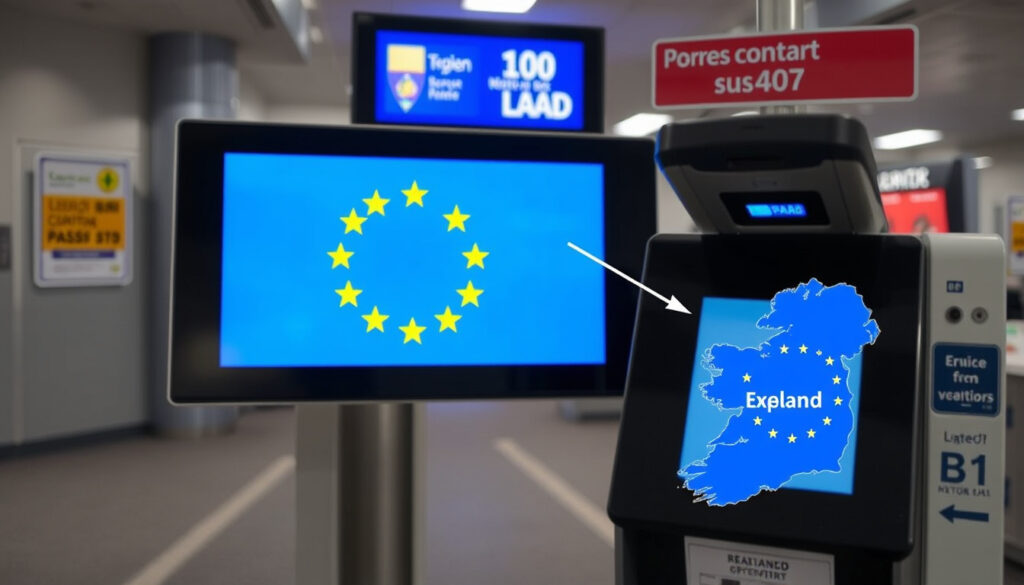
EU Entry Exit System: Rules, Dates & Irish Exemption
If you’re planning a trip to mainland Europe, you’ve probably started hearing about the EU’s new Entry/Exit System. The system went live on 12 October 2025, and it changes how non-EU travellers register at Schengen borders. This guide covers the rules, the start date, and what Irish passport holders need to know — because Ireland’s position outside Schengen means some travellers are exempt and others aren’t.
Start date: 12 October 2025 ·
Countries using EES: 29 Schengen member states ·
Who is registered: Non-EU nationals ·
Biometric data captured: Fingerprints & facial image ·
Pre-registration app: Travel to Europe mobile app
Quick snapshot
- EES started on 12 October 2025 (GOV.UK (UK government guidance))
- Irish citizens are EU citizens and exempt from EES registration (Irish Immigration Service Delivery)
- Pre-registration via the Travel to Europe app is available (ABTA (UK travel association))
- Biometrics are collected every three years for repeat travellers (Jet2 (airline operator guidance))
- Exact waiting times at border crossings after full rollout
- Whether Ireland will consider opting into Schengen (not currently planned)
- How EES will interact with the UK’s separate border system for non-Irish travellers
- Precise operational status of EES at all land borders during the transition period
- Interaction between EES and the future ETIAS system, and how they will work together at borders
- 2022 – initially scheduled but delayed (GOV.UK) (European Union – Travel to Europe)
- 2023–2024 – multiple technical and political delays (European Union – Travel to Europe)
- 12 October 2025 – system goes live (European Union – Travel to Europe)
- October 2025 – April 2026 – six-month transition period (European Union – Travel to Europe)
Seven key facts about the system, one pattern: EES digitises what was previously a manual process.
| Label | Value |
|---|---|
| System name | Entry/Exit System (EES) |
| Start date | 12 October 2025 |
| Scope | Schengen external borders (29 countries) |
| Data collected | Name, travel document, fingerprints, facial image, date/time of entry/exit |
| Biometric retention | 3 years |
| Pre-registration app | Travel to Europe (iOS & Android) |
| Exempted nationalities | EU/EEA/Swiss citizens, long-term residents, diplomats |
What are the new entry exit rules for the EU?
The EES is an automated IT system that registers non-EU nationals each time they cross an external Schengen border. It replaces manual passport stamping and collects biometric data — fingerprints and a facial image — for short stays of up to 90 days in any 180-day period (European Union – Travel to Europe). The system applies to both visa-required and visa-exempt non-EU travellers (Irish Immigration Service Delivery). EU, EEA and Swiss citizens are exempt.
Who is affected by EES?
- Non-EU nationals (including British, American, Canadian, Australian citizens)
- Exempt: EU/EEA/Swiss citizens (including Irish passport holders), long-stay visa holders, residence permit holders (Irish Immigration Service Delivery)
What data is collected?
- Name, travel document type and number, fingerprints (four fingers), facial image, date and time of entry/exit (Jet2)
- Children under 12 do not need to provide fingerprints (Jet2)
How long does a short stay cover?
The 90/180-day rule continues: non-EU nationals can stay up to 90 days in any 180-day period within Schengen. EES automatically calculates remaining days (European Union – Travel to Europe).
Children under 12 are exempt from fingerprinting, but still need a facial image. Families should budget extra time at border kiosks during the first year of operation.
Will Irish citizens need EES?
No. Irish passport holders are EU citizens and therefore not subject to the Entry/Exit System when entering or leaving the Schengen area (Irish Immigration Service Delivery). Ireland is not part of Schengen, so EES does not operate at Irish airports or seaports. The Irish government advises carrying a passport or national ID card as proof of nationality (Irish Immigration Service Delivery).
Are Irish passport holders treated as EU citizens?
Yes. Ireland is a full EU member state. Irish citizens enjoy the same free-movement rights as other EU nationals when travelling to Schengen countries.
Does EES apply to Ireland itself?
No. Because Ireland remains outside Schengen, it does not participate in the EES. The Common Travel Area (CTA) with the UK is unaffected (Irish Immigration Service Delivery).
What about non-EU family members travelling with Irish citizens?
Non-EU family members of Irish citizens are third-country nationals and may need to comply with EES if they are not long-term residents. However, holders of an Irish Residence Permit linked to an EU citizen are exempt in that specific context (Irish Immigration Service Delivery). The recommendation: carry both the passport and the residence document.
Can I pre-register for EES?
Yes. The official “Travel to Europe” mobile app allows you to submit your travel document details and a facial image before you travel. You can also complete an entry-conditions questionnaire (ABTA). Pre-registration is not mandatory, but it is recommended to reduce waiting times at the border. You can store passport data in the app for future trips.
How does the Travel to Europe app work?
- Available on iOS and Android free of charge
- You upload a photo of your passport and take a live selfie for facial matching
- The app sends your data to the national border authority before you arrive
What documents do I need to pre-register?
- A valid passport (with at least 3 months’ validity)
- No visa needed for visa-exempt nationalities; visa holders enter the visa number
Is pre-registration mandatory?
No. You can complete the full registration at a self-service kiosk on arrival. The first registration always requires fingerprints and a facial image (Jet2). Pre-registration just saves you queuing at the kiosk.
The Travel to Europe app is the smart play for frequent travellers. It stores your passport data for future trips and shaves minutes off the border process. Infrequent travellers can safely skip it and register on arrival.
Do I have to do EES every time?
Yes, every entry and exit at an external Schengen border will be registered in EES. However, biometric data is stored for up to three years, so repeat crossings may only require a quick verification (scan your passport and your face) rather than a full re-registration (Jet2).
Are there any exemptions for frequent travellers?
No. Non-EU frequent travellers, including business commuters, must go through EES each time. There is no trusted-traveller lane under the current rules.
Does EES replace passport stamps?
Yes. Once EES is fully operational, passport stamps for non-EU nationals will be phased out. The digital record replaces the physical ink (European Union – Travel to Europe).
Will I need to re-register biometrics on each visit?
No. Biometrics are retained for three years. After that, you will need to provide fingerprints and a facial image again on your next visit. If your passport changes (loss, expiry), you must re-register immediately.
When does the Entry/Exit System start?
EES began operation on 12 October 2025 (GOV.UK). The original target was 2022, but technical integration and political negotiations caused multiple delays. Member states have been given a six-month transition period – until April 2026 – to fully implement the system at all border crossing points. Some land borders may operate a phased rollout during this window.
Why was EES delayed?
The system required new IT infrastructure at every Schengen external crossing point, plus coordination between 29 countries. Technical integration with national border systems proved more complex than anticipated.
What was the previous expected start date?
Originally scheduled for 2022, then pushed to 2023, then 2024. Each delay was announced after the target date was missed. The eventual go-live in October 2025 was confirmed by the European Commission and the UK Home Office.
Will there be a phased rollout?
Yes. The transition period runs from October 2025 to April 2026. During this time, some borders may still use manual stamping as a fallback. By mid-2026, full interoperability is expected.
Which countries use the EES?
EES applies at the external borders of all 29 Schengen member states. This includes 25 EU member states (all except Ireland and Cyprus) plus Norway, Iceland, Switzerland, and Liechtenstein (Irish Immigration Service Delivery). The United Kingdom is not part of Schengen and does not use EES.
Are there any EU countries not using EES?
Yes. Ireland and Cyprus are EU members that remain outside Schengen. Neither uses EES. Travellers to Ireland continue to follow existing UK-Ireland border rules.
Does EES apply to non-EU Schengen countries?
Yes. Norway, Iceland, Switzerland, and Liechtenstein are Schengen-associated states and fully implement EES at their external borders. If you’re planning a trip, consider the Best Time to Visit Iceland: Seasons, Northern Lights & More to align your travel with the new EES procedures.
Will the UK be included?
No. The UK is outside the Schengen area. However, travellers entering Schengen from the UK (via Eurostar, Eurotunnel, or the Port of Dover) will complete EES checks before leaving the UK.
Steps to prepare for EES
- Download the Travel to Europe app from the official EU site (European Union – Travel to Europe)
- Scan your passport and take a live facial image
- Complete the entry-conditions questionnaire (optional but speeds up border processing)
- Bring your passport to the border – biometrics will be taken at a self-service kiosk
- For children under 12: no fingerprints required, but a facial image is captured
- Keep your passport handy for follow-up visits – just a quick scan usually suffices
No action is required for EU citizens (including Irish). The system is automated – you do not need to apply or pay any fee. For those planning multi-country rail journeys, check out our guide to Train Routes in Europe: Maps, Best & Scenic Routes to navigate Schengen borders smoothly.
Timeline
- 2022 (original): EES initially scheduled to launch but delayed (GOV.UK)
- 2023–2024: Multiple delays due to technical integration and political negotiations
- 12 October 2025: EES officially enters into operation across all Schengen external borders (European Union – Travel to Europe)
- October 2025 – April 2026: Six-month transition period for full implementation at all border crossing points
What is confirmed and what is unclear
Confirmed facts
- EES started on 12 October 2025 (GOV.UK)
- Irish citizens are EU citizens and exempt from EES registration (Irish Immigration Service Delivery)
- Pre-registration via Travel to Europe app is available (ABTA)
- Schengen countries include 29 member states (Irish Immigration Service Delivery)
- Biometrics (fingerprints & photo) are collected every three years (Jet2)
What’s unclear
- Exact waiting times at border crossings after full rollout
- Whether Ireland will consider opting into Schengen (not currently planned)
- How EES will interact with the UK’s separate border system for non-Irish travellers
- Precise operational status of EES at all land borders during the transition period
- Interaction between EES and the future ETIAS system, and how they will work together at borders
Expert perspectives
“The Entry/Exit System (EES) will register non-EU nationals each time they cross the external borders of European countries.”
European Union – official EES website
“Irish citizens, as EU nationals, are not subject to the Entry/Exit System when entering or leaving the Schengen area.”
Irish government – Department of Justice
“The EU’s Entry/Exit System (EES) started on 12 October 2025. This is a new digital border system that has changed requirements for British travellers.”
UK Government – Home Office
For the Irish traveller, the consequence is clear: pack your passport as always, download the app if you want to skip a queue, and leave the EES worries to non-EU visitors. The system is live, the rules are set, and Ireland’s unique position outside Schengen means its citizens remain unaffected. For non-EU travellers, the smart move is pre-register and budget an extra 10 minutes at the border.
Travelers with Irish passports should check the EES guide for Ireland for details on how the exemption works under the new system.
Frequently asked questions
What is the difference between EES and ETIAS?
EES is an entry/exit registration system that records when you cross the border. ETIAS is a travel authorisation (similar to ESTA) that you apply for before travelling. EES is already live; ETIAS is expected to launch later.
How will EES affect UK citizens after Brexit?
UK citizens are non-EU nationals and must register in EES for short stays in Schengen. They can use the Travel to Europe app to pre-register.
Will EES cause longer queues at airports?
Initial months may see longer queues as travellers and staff adjust. Pre-registering via the app can reduce waiting time. Biometric kiosks are designed to process a passenger in under 30 seconds.
Do I need a visa for Schengen after EES is introduced?
EES does not change visa requirements. If your nationality required a visa before, it still does. EES simply registers your entry/exit.
Can I use EES for multiple trips to different Schengen countries?
Yes. Once registered, EES records all entries and exits across the Schengen area. A single biometric registration covers all subsequent trips within the three-year validity.
What happens if I refuse to provide biometrics?
You may be denied entry to the Schengen area. Biometrics are mandatory for all non-EU nationals subject to EES.
Is there a grace period for travellers who haven’t pre-registered?
Yes. Pre-registration is optional; you can complete the process at the border. No penalty for not using the app.
More related posts
 Best Pens for Journaling: Smudge-Free Picks for Lefties
 Highest Mountain in Europe: Mount Elbrus at 5,642m Facts
 Love Island 2025 Contestants: Full Cast List and Updates
 Samsung Galaxy S25 FE: Specs, Price & Ireland Deals
 Swimming Lessons Near Me: Kids, Adults in Drogheda & Tallaght
 La Cala de Mijas Guide: Worth Visiting? Things to Do & Tips
 Galaxy C Series to Buy: Best Ireland Refurb Deals
 What Is a Kafka Topic – Definition, Uses, Architecture